How to Find the Volume of a Cylinder Using Diameter
Find the volume of a cylinder from its diameter with V = πd²h/4. Step-by-step method, pipe example, a diameter table and the most common mistake.
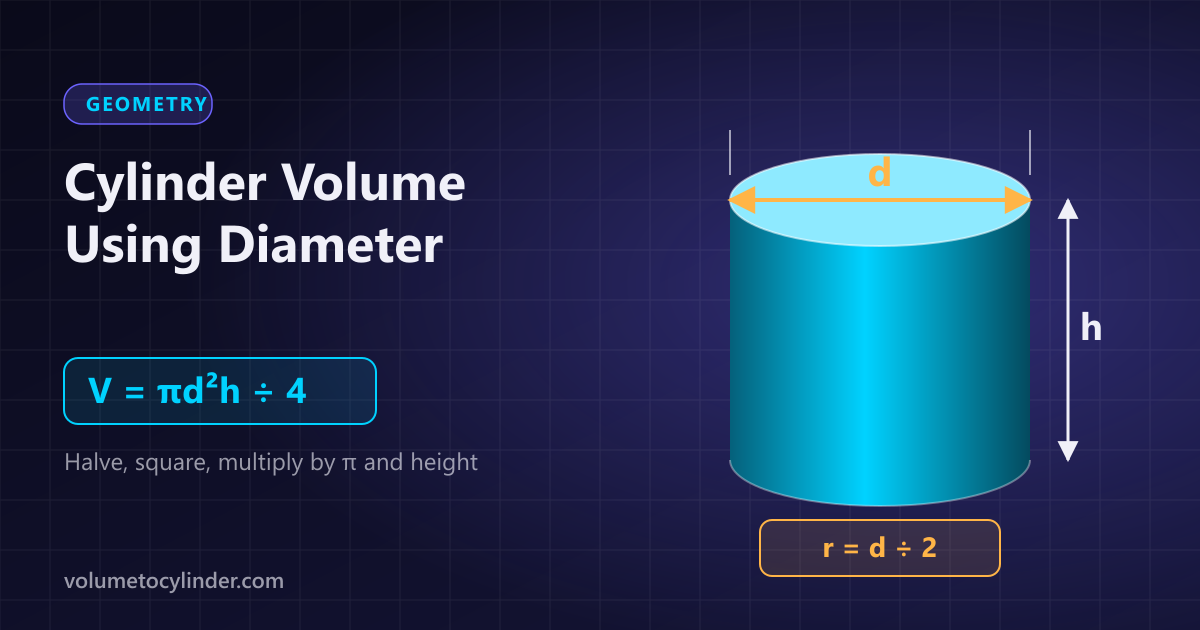
To find the volume of a cylinder using diameter, use V = πd²h ÷ 4, where d is the diameter and h is the height. The formula gives the same answer as V = πr²h, with the halving of the diameter built in.
Most real objects give you the diameter, not the radius. A tape measure or caliper reads straight across a can. Pipes are sold by diameter, such as a 4-inch pipe or a 110 mm pipe. Finding the exact centre of a circle to measure the radius is hard, but measuring edge to edge is easy.
The using-diameter calculator runs this formula for you.
What Is the Formula for the Volume of a Cylinder Using Diameter?
The formula for the volume of a cylinder using diameter is V = π(d/2)²h, which simplifies to V = πd²h/4.
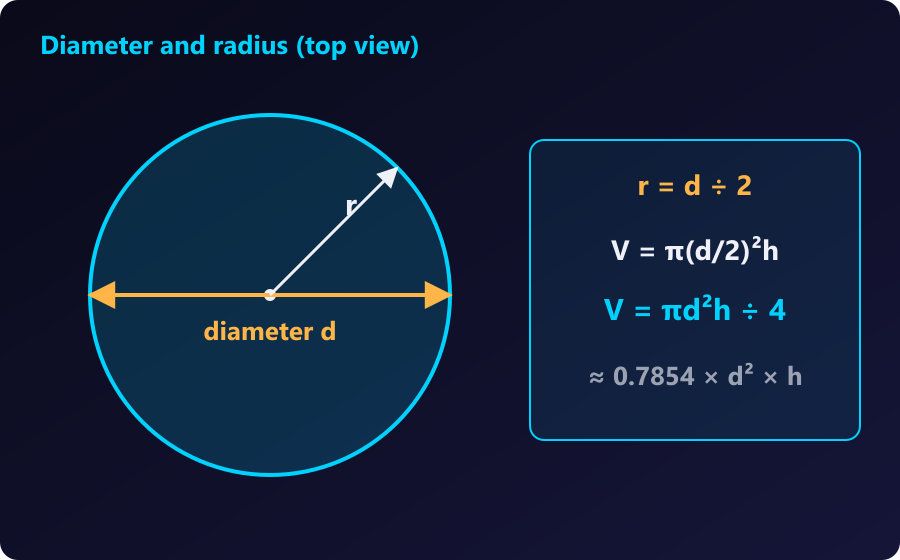
The radius is half the diameter (r = d/2). Substituting r = d/2 into V = πr²h gives:
- V = π × (d/2)² × h
- V = π × (d²/4) × h
- V = πd²h/4
π ÷ 4 ≈ 0.7854, so a quick version of the formula is V ≈ 0.7854 × d² × h. Engineers use 0.7854 for pipe and bore calculations.
How Do You Find the Volume of a Cylinder from Its Diameter?
To find the volume of a cylinder from its diameter, follow 4 steps:
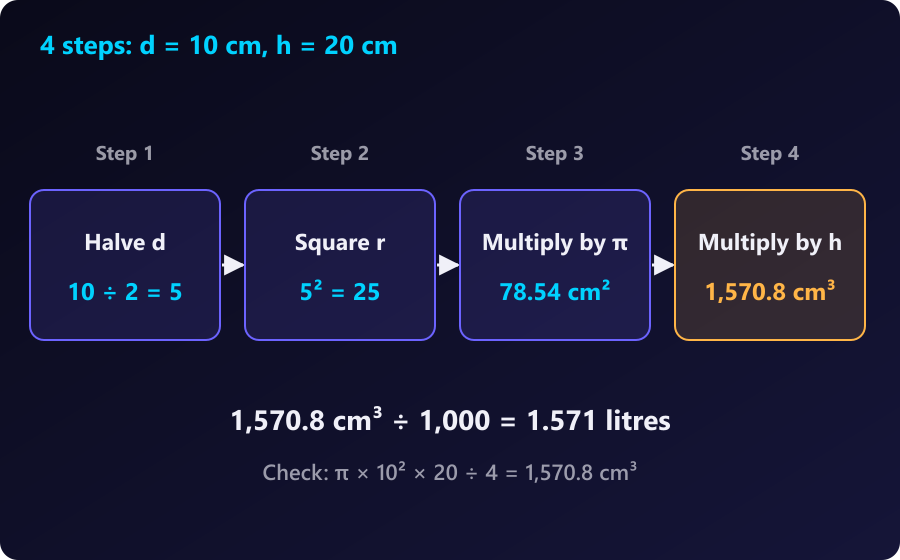
- Halve the diameter to get the radius: r = d ÷ 2.
- Square the radius: r × r.
- Multiply by π to get the base area.
- Multiply by the height to get the volume.
Keep the diameter and height in the same unit before you start.
Worked Example 1: Diameter 10 cm, Height 20 cm
A cylinder with a diameter of 10 cm and a height of 20 cm has a volume of about 1,570.8 cm³ (1.57 L).
- Halve the diameter: r = 10 ÷ 2 = 5 cm.
- Square the radius: 5² = 25 cm².
- Multiply by π: π × 25 ≈ 78.54 cm².
- Multiply by the height: 78.54 × 20 ≈ 1,570.8 cm³.
Check with the direct formula: V = π × 10² × 20 ÷ 4 = π × 2,000 ÷ 4 = π × 500 ≈ 1,570.8 cm³. Both methods match. 1,570.8 cm³ ÷ 1,000 = 1.571 litres (L).
Worked Example 2: Water in a 4-Inch Pipe That Is 3 Feet Long
A 4-inch pipe that is 3 feet long holds about 452.4 cubic inches (in³), which equals 1.96 US gallons (gal) or 7.41 litres.
This example mixes inches (in) and feet (ft), so convert first.
- Match the units. Length = 3 ft × 12 = 36 in. Diameter = 4 in.
- Halve the diameter. r = 4 ÷ 2 = 2 in.
- Square the radius. 2² = 4 in².
- Multiply by π. π × 4 ≈ 12.566 in².
- Multiply by the length. 12.566 × 36 ≈ 452.39 in³.
- Convert to gallons. 1 US gallon = 231 in³, so 452.39 ÷ 231 ≈ 1.958 gal.
- Convert to litres. 1 in³ = 0.016387 L, so 452.39 × 0.016387 ≈ 7.41 L.
Use the inside diameter (ID) to find how much water a pipe holds. A “4-inch” pipe is a nominal pipe size (NPS), and the real inside diameter of a 4-inch Schedule 40 steel pipe is about 4.026 in. Measure the bore, if the answer must be exact. Use the outside diameter (OD) and ID together, if you need the volume of pipe material. The hollow cylinder guide covers that case.
What Is the Biggest Mistake When Using Diameter?
The biggest mistake is forgetting to halve the diameter. Putting the diameter into πr²h makes the answer 4 times too big, since squaring doubles the error: (2r)² = 4r².
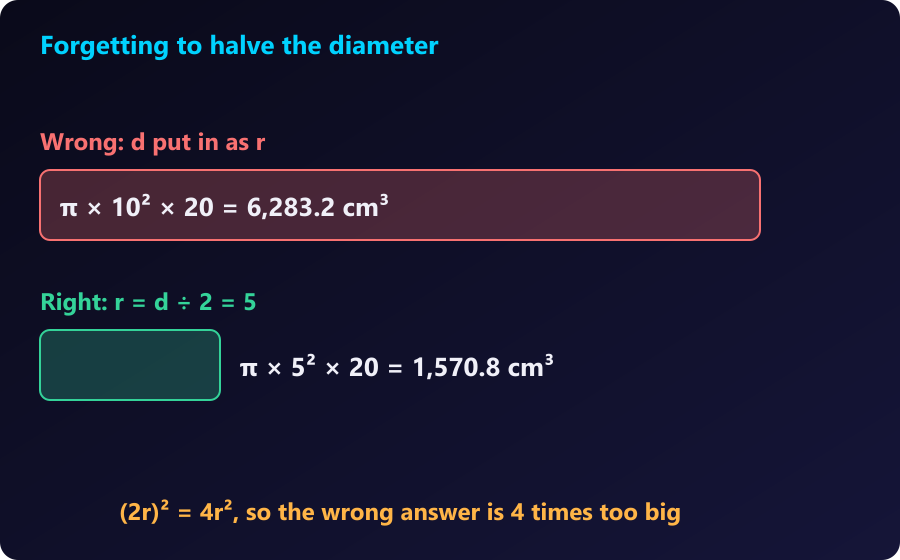
Example: d = 10 cm, h = 20 cm.
- Wrong: π × 10² × 20 ≈ 6,283.2 cm³.
- Right: π × 5² × 20 ≈ 1,570.8 cm³.
6,283.2 ÷ 1,570.8 = 4. An answer exactly 4 times the expected size points to this mistake.
There are 2 more mistakes to watch for:
- Mixed units. A diameter in inches and a length in feet give a meaningless number. Convert both to inches or both to feet.
- Wrong diameter. Measure across the widest part of the circle, through the centre. A tape placed off-centre reads short.
Why Does a Cylinder Fill 78.5% of Its Box?
A cylinder fills π ÷ 4 ≈ 78.5% of the square box it fits in. That’s where the 0.7854 in pipe formulas comes from.
Put a can in a box that just fits it. The box has a square base with sides of length d, so its volume is d × d × h = d²h. The can’s volume is 0.7854 × d²h. The 4 corners of the box hold the other 21.5% as empty air.
This gives a fast way to check any diameter answer:
- Work out the box: d × d × h.
- Take about three quarters of it, then add a little.
- Your answer should sit close to that number.
For d = 10 cm and h = 20 cm, the box is 2,000 cm³. Three quarters is 1,500 cm³. The real answer, 1,570.8 cm³, sits just above it.
Shippers use the same fact. 100 cans packed in a grid waste 21.5% of the carton space, whatever the can size.
How Do You Measure Diameter on a Real Object?
To measure diameter on a real object, read straight across the widest part, through the centre, in 2 directions at right angles. Average the 2 readings.
The tool depends on the size:
- Small parts (under 15 cm): use calipers. Close the jaws on the outside for OD, open them inside the bore for ID.
- Buckets, pots and drums: lay a straight rule across the open top and slide it until the reading is largest. That’s the diameter.
- Tanks, trees and pillars: wrap a tape around the outside to get the circumference, then divide by π. d = C ÷ π. The circumference guide covers this method.
Measure in 2 directions since real objects are rarely perfect circles. A plastic water butt can bulge 1–2 cm wider one way when full. If the readings differ by more than 2%, average them.
For containers, measure the inside. A drum’s wall and rolled rim can add 1–2 cm to the outside reading. On a 57 cm drum, measuring 1 cm too wide inflates the volume by about 3.5%.
Worked Example 3: A Round Water Trough
A round livestock trough with an inside diameter of 1.8 m and a depth of 0.6 m holds about 1,527 litres when full.
- Square the diameter. 1.8² = 3.24 m².
- Multiply by 0.7854. 3.24 × 0.7854 ≈ 2.545 m². This is the base area.
- Multiply by the depth. 2.545 × 0.6 ≈ 1.527 m³.
- Convert to litres. 1.527 × 1,000 ≈ 1,527 L.
Water weighs 1 kg per litre, so the full trough holds about 1.53 tonnes of water. A trough filled to 10 cm below the rim holds 1,527 × 0.5 ÷ 0.6 ≈ 1,272 L.
Mini Calculator Table: Volume per Unit of Height by Diameter
This table gives the volume of a cylinder for 1 unit of height. Multiply the value by your height to get the total volume.
Metric diameters (volume per 1 cm of height and per 1 m of length)
| Diameter (cm) | Base area (cm²) = volume per 1 cm height (cm³) | Litres per 1 m length |
|---|---|---|
| 1 | 0.79 | 0.079 |
| 2 | 3.14 | 0.314 |
| 3 | 7.07 | 0.707 |
| 4 | 12.57 | 1.257 |
| 5 | 19.63 | 1.963 |
| 6 | 28.27 | 2.827 |
| 8 | 50.27 | 5.027 |
| 10 | 78.54 | 7.854 |
| 12 | 113.10 | 11.310 |
| 15 | 176.71 | 17.671 |
| 20 | 314.16 | 31.416 |
| 25 | 490.87 | 49.087 |
| 30 | 706.86 | 70.686 |
| 50 | 1,963.50 | 196.350 |
| 100 | 7,853.98 | 785.398 |
Imperial diameters (volume per 1 inch of height and per 1 foot of length)
| Diameter (in) | Volume per 1 in height (in³) | US gallons per 1 ft length |
|---|---|---|
| 0.5 | 0.196 | 0.0102 |
| 0.75 | 0.442 | 0.0229 |
| 1 | 0.785 | 0.0408 |
| 1.5 | 1.767 | 0.0918 |
| 2 | 3.142 | 0.1632 |
| 3 | 7.069 | 0.3672 |
| 4 | 12.566 | 0.6528 |
| 6 | 28.274 | 1.4688 |
| 8 | 50.265 | 2.6112 |
| 10 | 78.540 | 4.0800 |
| 12 | 113.097 | 5.8752 |
Example: a 6-inch pipe that is 20 ft long holds 1.4688 × 20 ≈ 29.4 US gallons.
Frequently Asked Questions
Can I use the diameter instead of the radius in the cylinder volume formula?
Yes, you can use the diameter, with the formula V = πd²h/4. Do not put the diameter into V = πr²h, since the answer comes out 4 times too big.
How do I find the radius from the diameter?
Divide the diameter by 2. A cylinder with a diameter of 18 cm has a radius of 9 cm.
What is 0.7854 in pipe volume formulas?
0.7854 is π ÷ 4 rounded to 4 decimal places. Volume = 0.7854 × d² × length gives the same result as πd²h/4.
Which diameter do I use for a pipe?
Use the inside diameter (ID) to find how much liquid a pipe holds. Use the outside diameter (OD) and the inside diameter together to find the volume of the pipe wall.
How do I find the diameter if I only know the circumference?
Divide the circumference by π: d = C ÷ π. The circumference guide shows the full volume method.
How much of a square box does a cylinder fill?
A cylinder fills π ÷ 4, or about 78.5%, of the square box it fits in. The other 21.5% sits in the 4 corners.
Should I measure the inside or outside diameter of a container?
Measure the inside diameter to find how much a container holds. The outside diameter includes the wall, so it gives an answer that is too big.