Finding Height or Radius from the Volume of a Cylinder
Find a cylinder's height with h = V/(πr²) and its radius with r = √(V/πh). Worked examples, a 1,000 L tank design and unit pitfalls.
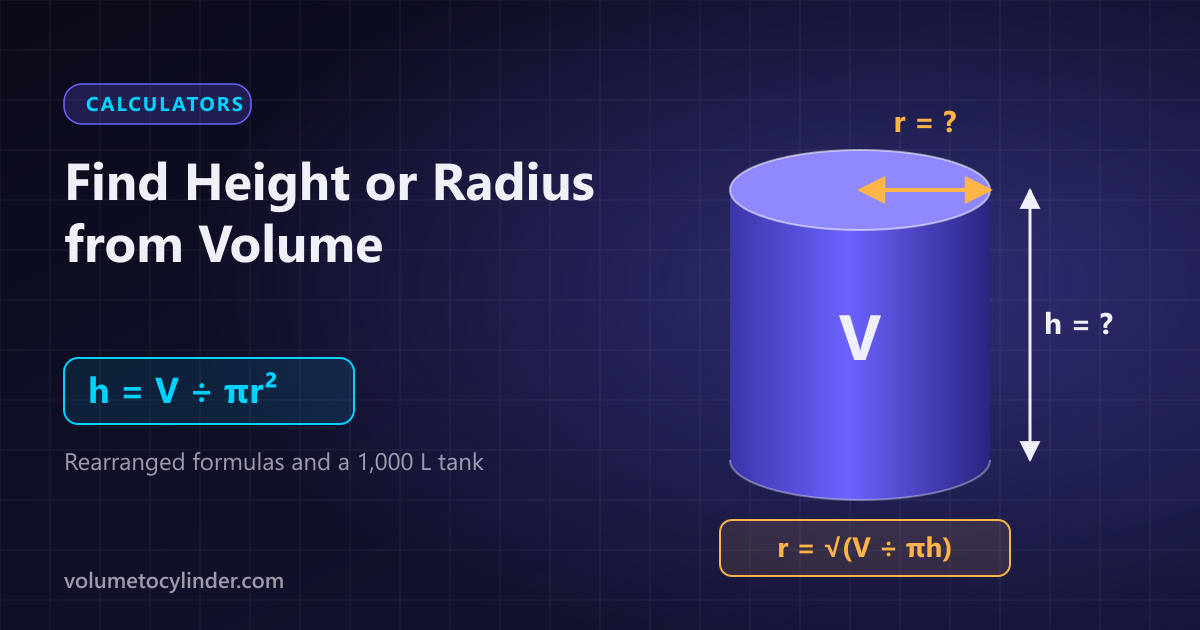
To find the height of a cylinder from its volume, use h = V ÷ (πr²). To find the radius, use r = √(V ÷ πh). Both formulas come from rearranging V = πr²h.
Reverse problems come up whenever you know the volume and need a size. A tank must hold 500 L, so how tall does it need to be? A can must hold 330 ml, so how wide is it? This guide shows each rearrangement, worked examples, a real tank design, and the unit mistakes that break most answers. The without-height calculator and the without-radius calculator solve both cases.
How Do You Rearrange the Cylinder Volume Formula?
To rearrange the cylinder volume formula, undo each operation on the unknown, one step at a time. V = πr²h has 2 rearranged forms:
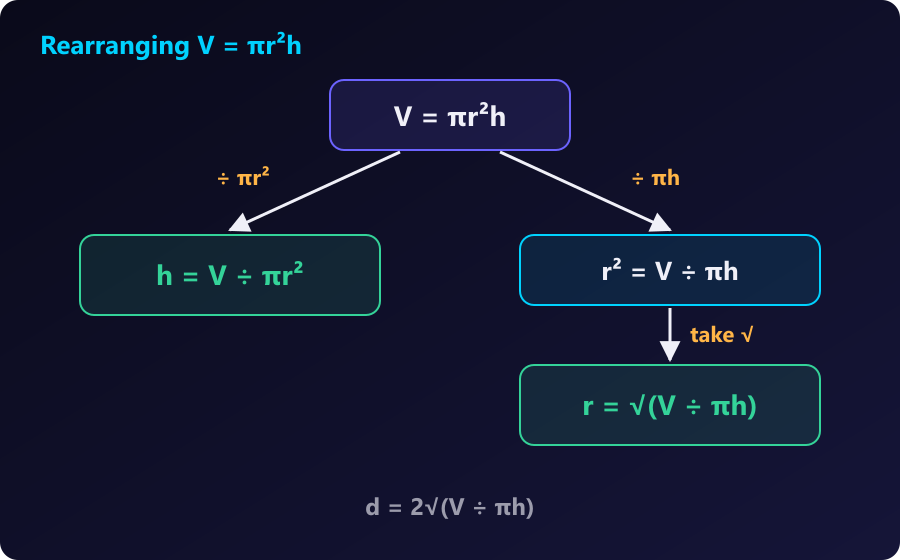
Height formula: h = V ÷ (πr²)
- Start with V = πr²h.
- Divide both sides by πr².
- Result: h = V ÷ (πr²).
Radius formula: r = √(V ÷ πh)
- Start with V = πr²h.
- Divide both sides by πh: r² = V ÷ (πh).
- Take the square root of both sides.
- Result: r = √(V ÷ πh).
The height formula divides by the base area. The radius formula needs a square root, since r is squared in the original formula.
How Do You Find the Height of a Cylinder from Its Volume?
To find the height of a cylinder, divide the volume by the base area πr².
Example. A cylindrical tank must hold 500 L and has a radius of 40 cm. Find the height.
- Convert litres to cm³. 500 L × 1,000 = 500,000 cm³. The radius is in cm, so the volume must be in cm³.
- Find the base area. πr² = π × 40² = π × 1,600 ≈ 5,026.5 cm².
- Divide. h = 500,000 ÷ 5,026.5 ≈ 99.47 cm.
- Check. π × 40² × 99.47 ≈ 499,990 cm³ ≈ 500 L. The answer is correct.
The tank needs a height of about 99.5 cm (39.2 in) to hold 500 L.
How Do You Find the Radius of a Cylinder from Its Volume?
To find the radius of a cylinder, divide the volume by π times the height, then take the square root.
Example. A cylinder has a volume of 2,000 cm³ and a height of 15 cm. Find the radius.
- Multiply π by the height. π × 15 ≈ 47.124.
- Divide the volume. 2,000 ÷ 47.124 ≈ 42.441. This is r².
- Take the square root. r = √42.441 ≈ 6.515 cm.
- Check. π × 6.515² × 15 ≈ 2,000.2 cm³. The small gap comes from rounding.
How Do You Find the Diameter of a Cylinder from Its Volume?
To find the diameter, double the radius formula: d = 2√(V ÷ πh).
Using the previous example: d = 2 × 6.515 ≈ 13.03 cm.
The diameter version saves a step when you buy pipe, tube, or tank stock, since suppliers list sizes by diameter. There is a second form, d = √(4V ÷ πh), which gives the same number.
Real Design Example: A 1,000-Litre Tank That Must Fit Under 1.2 m
A rainwater tank must hold 1,000 L and fit under a window ledge 1.2 m high. The tank needs a diameter of at least 1.03 m, or 1.08 m with 10% freeboard.
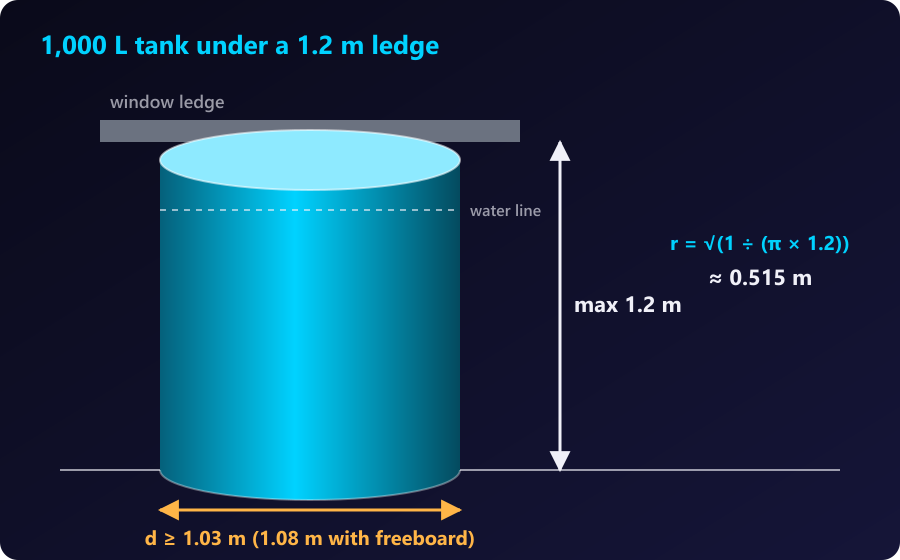
- Convert the capacity to m³. 1,000 L = 1 m³.
- Set the height. h = 1.2 m, the maximum the space allows.
- Find the radius. r = √(1 ÷ (π × 1.2)) = √0.26526 ≈ 0.515 m.
- Find the diameter. d = 2 × 0.515 ≈ 1.030 m.
- Add freeboard. Tanks need space above the water line for the inlet and overflow. For 10% freeboard, design for 1,100 L: r = √(1.1 ÷ (π × 1.2)) ≈ 0.540 m, so d ≈ 1.08 m.
A stock tank with a diameter of 1.1 m and a height of 1.2 m holds π × 0.55² × 1.2 ≈ 1.140 m³ (1,140 L), so it meets the brief with spare room. The tank’s footprint is π × 0.55² ≈ 0.95 m², which tells you whether it fits the space at the base.
What Are the Unit Pitfalls When Solving for Height or Radius?
There are 4 unit pitfalls when solving for height or radius:
- Litres not converted. 1 L = 1,000 cm³ and 1 m³ = 1,000 L. Convert litres to cm³ before solving, if the known length is in cm. Convert litres to m³, if the known length is in m.
- Mixed length units. A radius in mm and a volume in cm³ give a height that is off by a factor of 10 or more. Use one length unit throughout.
- Gallons in a metric formula. Convert US gallons to cubic inches (× 231) to solve with inches, or to litres (× 3.785) to solve with metric units.
- Square root of the wrong unit. r² comes out in square units (cm²). The square root returns cm. A radius answer in cm² means the square root step was skipped.
| Known volume | Known length unit | Convert volume to |
|---|---|---|
| Litres (L) | cm | cm³ (× 1,000) |
| Litres (L) | m | m³ (÷ 1,000) |
| Millilitres (ml) | cm | cm³ (× 1) |
| US gallons | in | in³ (× 231) |
| US gallons | ft | ft³ (÷ 7.4805) |
The cylinder volume conversions guide lists every factor.
How Do You Find the Liquid Level from a Volume?
To find how high a known volume of liquid sits in an upright cylinder, use the height formula with the liquid volume: level = V ÷ (πr²). This is the same rearrangement, aimed at the liquid instead of the container.
Example. You pour 300 L into a vertical tank with an inside diameter of 1 m.
- Convert: 300 L = 0.3 m³.
- Radius: r = 0.5 m. Base area: π × 0.5² ≈ 0.7854 m².
- Level: 0.3 ÷ 0.7854 ≈ 0.382 m, or 38.2 cm.
Each 100 L raises the level by 0.1 ÷ 0.7854 ≈ 12.7 cm. Mark the outside of the tank every 12.7 cm and you have a gauge that reads in 100 L steps. This only works for upright tanks. A horizontal tank’s level climbs at a changing rate, so it needs the fill chart in the tank guide.
How Do You Find Radius and Height When the Shape Is Set?
Sometimes you know the volume and the proportions, but neither length. A designer might want a jar 3 times as tall as its radius. Write h as a multiple of r, then solve with a cube root: r = ∛(V ÷ πk), where h = k × r.
Example. A 2-litre jar must be 3 times as tall as its radius (k = 3).
- Set up: V = πr² × 3r = 3πr³.
- Solve: r = ∛(2,000 ÷ (3π)) = ∛212.2 ≈ 5.96 cm.
- Height: h = 3 × 5.96 ≈ 17.89 cm.
- Check: π × 5.96² × 17.89 ≈ 1,996 cm³. Close to 2,000, with the gap from rounding.
For the material-saving shape h = 2r, use k = 2. A 2-litre can then needs r ≈ 6.83 cm and h ≈ 13.66 cm.
How Much Wider Does a Tank Get When You Double Its Capacity?
At a fixed height, doubling the volume makes the radius only 1.41 times bigger, since r grows with the square root of V. To double the diameter, you need 4 times the volume.
Take the 1,000 L tank limited to 1.2 m tall:
| Capacity | Height | Diameter needed |
|---|---|---|
| 1,000 L | 1.2 m | 1.03 m |
| 2,000 L | 1.2 m | 1.46 m |
| 4,000 L | 1.2 m | 2.06 m |
So a bigger tank under a height limit grows slower across than you’d guess. Check the footprint against the space at the base and the gate or door it has to pass through.
Practice Questions with Answers
- A cylinder has a volume of 785.4 cm³ and a radius of 5 cm. Find the height.
- A cylinder has a volume of 1,200 cm³ and a height of 12 cm. Find the radius.
- A 50-litre drum has a diameter of 30 cm. Find its height.
- A 10 m³ tank must be 4 m tall. Find its diameter.
- A 2-litre cylindrical container is 30 cm tall. Find its radius.
Answers
- h = 785.4 ÷ (π × 25) = 785.4 ÷ 78.54 = 10.00 cm.
- r = √(1,200 ÷ (π × 12)) = √31.831 ≈ 5.64 cm.
- 50 L = 50,000 cm³. r = 15 cm. h = 50,000 ÷ (π × 225) ≈ 70.74 cm.
- d = 2√(10 ÷ (π × 4)) = 2√0.79577 ≈ 2 × 0.892 ≈ 1.78 m.
- 2 L = 2,000 cm³. r = √(2,000 ÷ (π × 30)) = √21.221 ≈ 4.61 cm.
The practice questions post has more reverse problems in Level 4.
Frequently Asked Questions
How do you find the height of a cylinder without the radius?
You need a second measurement. Use the diameter (r = d ÷ 2), the circumference (r = C ÷ 2π), or the base area (h = V ÷ base area). The volume alone does not fix the height.
Can you find the radius from the volume alone?
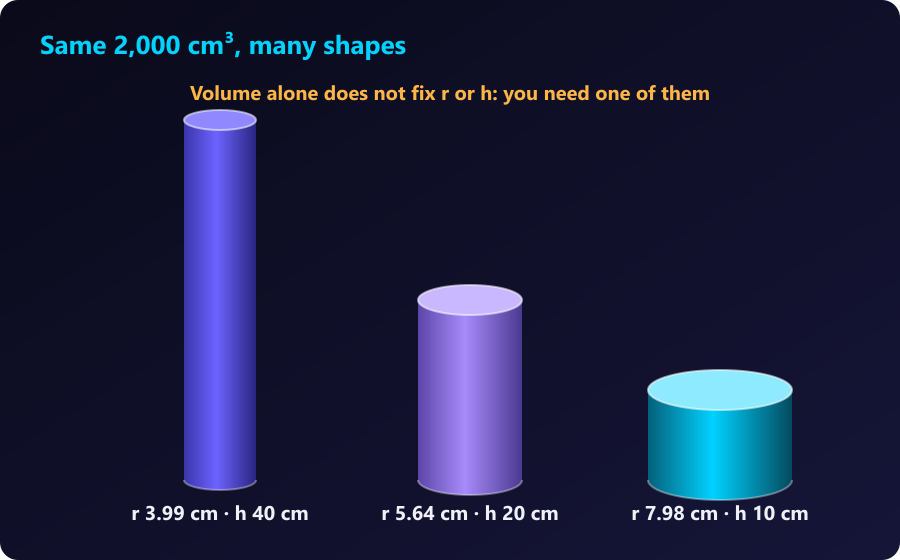
No, the volume alone does not give the radius. Many cylinders share the same volume: a tall thin one and a short wide one. You need the height as well.
How do you find the height from the surface area?
Rearrange the total surface area formula: h = TSA ÷ (2πr) − r. The surface area calculator handles this case.
How high will a given volume of water fill a cylinder?
Divide the volume by the base area: level = V ÷ (πr²). 300 L in a tank 1 m across fills it to 0.3 ÷ 0.7854 ≈ 0.38 m.
Can you find the radius and height from the volume if the ratio is known?
Yes. Write the height as a multiple of the radius, h = k × r, then use r = ∛(V ÷ πk). Multiply r by k to get the height.