Cylinder Volume Conversions: Litres, Gallons, m³, ml and Cubic Yards
Convert cylinder volume between cm³, litres, ml, m³, US and UK gallons and cubic yards, with a full table, worked examples and volume to weight.
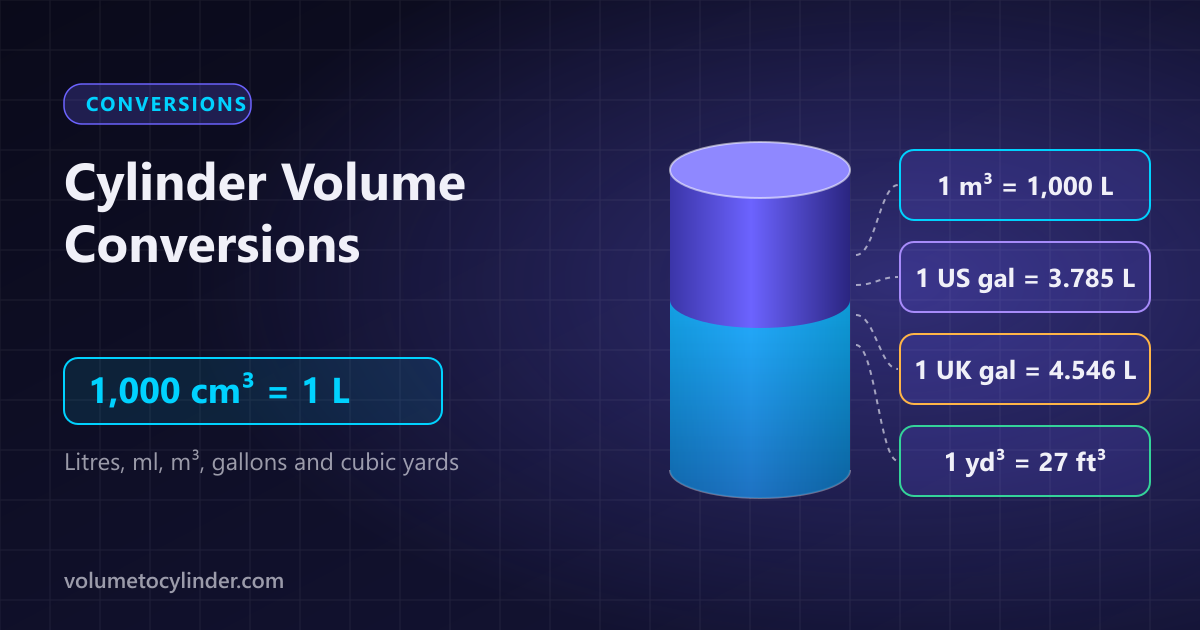
To convert a cylinder’s volume, divide cm³ by 1,000 to get litres, and divide litres by 3.785 to get US gallons. The formula V = πr²h gives volume in cubic units of whatever length you measured, such as cubic centimetres (cm³) or cubic metres (m³). Fuel, water, paint, and concrete are sold in litres (L), gallons (gal), or cubic yards (yd³), so the last step is a unit conversion.
This guide lists the conversion facts, gives a full conversion table, and works through 3 real examples. The litres calculator and gallons calculator do the conversion for you.
What Are the Key Cylinder Volume Conversion Facts?
There are 6 key conversion facts for cylinder volume:
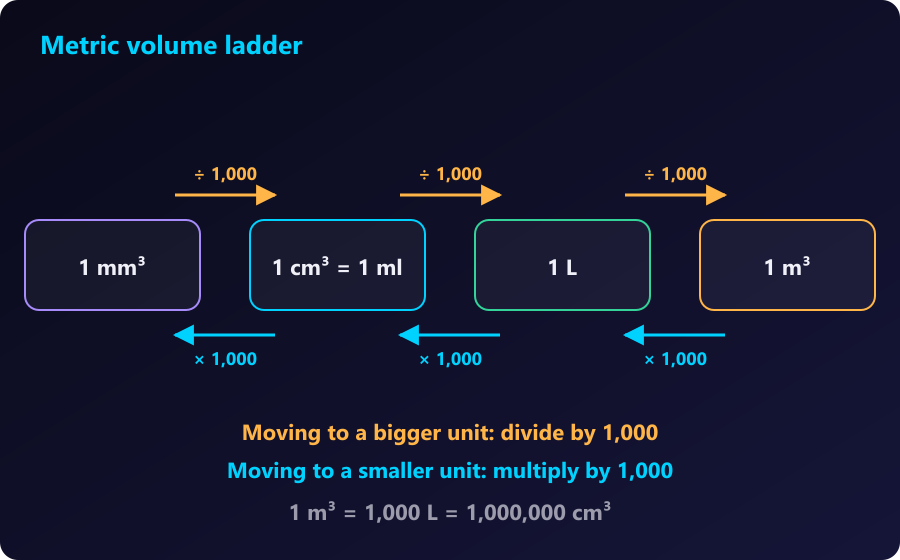
- 1,000 cm³ = 1 L. A litre is a cube 10 cm on each side.
- 1 cm³ = 1 millilitre (ml). The two units are identical.
- 1 m³ = 1,000 L. A cubic metre holds 1,000 litres.
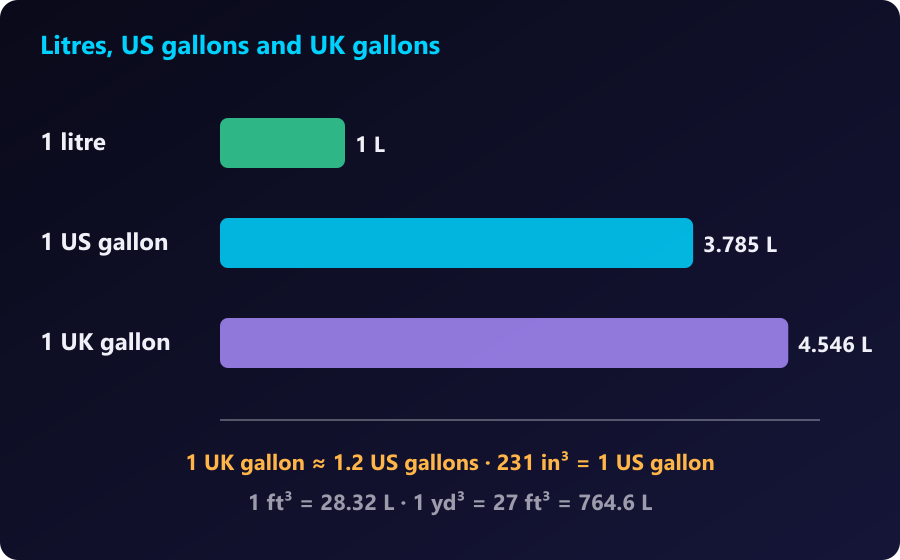
- 1 US gallon ≈ 3.785 L. One US gallon is exactly 231 cubic inches (in³).
- 1 imperial (UK) gallon ≈ 4.546 L. A UK gallon is about 20% bigger than a US gallon.
- 1 cubic yard = 27 cubic feet (ft³) ≈ 764.6 L. A cubic yard is a cube 3 ft on each side.
The National Institute of Standards and Technology (NIST) defines the US gallon as 231 in³ and the inch as 2.54 cm exactly.
Cylinder Volume Conversion Table
Read across a row to convert 1 unit of the left column into the other units.
| 1 unit of | Litres (L) | Cubic metres (m³) | Cubic feet (ft³) | US gallons | UK gallons | Cubic yards (yd³) |
|---|---|---|---|---|---|---|
| 1 cm³ (1 ml) | 0.001 | 0.000001 | 0.0000353 | 0.000264 | 0.00022 | 0.00000131 |
| 1 L | 1 | 0.001 | 0.03531 | 0.2642 | 0.2200 | 0.001308 |
| 1 in³ | 0.01639 | 0.0000164 | 0.000579 | 0.004329 | 0.003605 | 0.0000214 |
| 1 ft³ | 28.317 | 0.02832 | 1 | 7.4805 | 6.2288 | 0.03704 |
| 1 US gal | 3.7854 | 0.003785 | 0.13368 | 1 | 0.8327 | 0.004951 |
| 1 UK gal | 4.5461 | 0.004546 | 0.16054 | 1.2009 | 1 | 0.005946 |
| 1 m³ | 1,000 | 1 | 35.315 | 264.17 | 219.97 | 1.3080 |
| 1 yd³ | 764.55 | 0.76455 | 27 | 201.97 | 168.18 | 1 |
There are 4 shortcut rules from the table:
- cm³ → L: divide by 1,000.
- m³ → L: multiply by 1,000.
- in³ → US gal: divide by 231.
- ft³ → yd³: divide by 27.
Example in Litres: Volume of a Water Drum
A steel water drum with an inside diameter of 57 cm and a height of 85 cm holds about 216.9 L (57.3 US gallons).
- Find the radius. r = 57 ÷ 2 = 28.5 cm.
- Square the radius. 28.5² = 812.25 cm².
- Multiply by π and the height. V = π × 812.25 × 85 ≈ 216,899 cm³.
- Convert cm³ to litres. 216,899 ÷ 1,000 ≈ 216.9 L.
- Convert litres to US gallons. 216.9 ÷ 3.785 ≈ 57.3 US gal.
This drum matches the size of a standard “55-gallon” drum. The extra 2.3 gallons is headspace above the fill line.
Example in Gallons: A Tank Measured in Inches
A cylindrical tank with a diameter of 24 inches and a height of 48 inches holds about 94.0 US gallons (355.8 L).
- Find the radius. r = 24 ÷ 2 = 12 in.
- Calculate the volume in cubic inches. V = π × 12² × 48 = π × 6,912 ≈ 21,714.7 in³.
- Convert to US gallons. 21,714.7 ÷ 231 ≈ 94.0 US gal.
- Convert to UK gallons, if needed. 94.0 × 0.8327 ≈ 78.3 UK gal.
Convert feet to inches first (1 ft = 12 in), if the tank height is given in feet. Use 1 ft³ = 7.4805 US gallons, if you work in feet throughout. A 2 ft × 4 ft tank gives π × 1² × 4 ≈ 12.566 ft³, and 12.566 × 7.4805 ≈ 94.0 gallons, the same answer.
Example in Cubic Yards: A Concrete Column and a Round Planter
Ready-mix concrete and bulk soil are sold by the cubic yard, so cylinder volume in cubic feet needs one more division by 27.
Concrete Column
A round concrete column with a diameter of 18 in (1.5 ft) and a height of 10 ft needs about 0.65 cubic yards of concrete.
- Radius: 1.5 ÷ 2 = 0.75 ft.
- Volume: π × 0.75² × 10 ≈ 17.67 ft³.
- Cubic yards: 17.67 ÷ 27 ≈ 0.654 yd³.
- Metric check: 17.67 ft³ × 0.02832 ≈ 0.500 m³.
Concrete suppliers add 5–10% for waste and spillage, so order 0.7 yd³ for this column.
Round Planter
A round planter with a diameter of 3 ft and a depth of 2 ft holds about 0.52 cubic yards (14.1 ft³ or 400 L) of soil.
- Radius: 3 ÷ 2 = 1.5 ft.
- Volume: π × 1.5² × 2 ≈ 14.14 ft³.
- Cubic yards: 14.14 ÷ 27 ≈ 0.524 yd³.
- Bags: 14.14 ÷ 1.5 ft³ per bag ≈ 9.4, so buy 10 bags of 1.5 ft³ potting soil.
How Do You Convert Cylinder Volume to Weight?
To convert cylinder volume to weight, multiply the volume by the density of the material: mass = volume × density. The volume and density must share a unit, such as litres with kg/L or m³ with kg/m³.
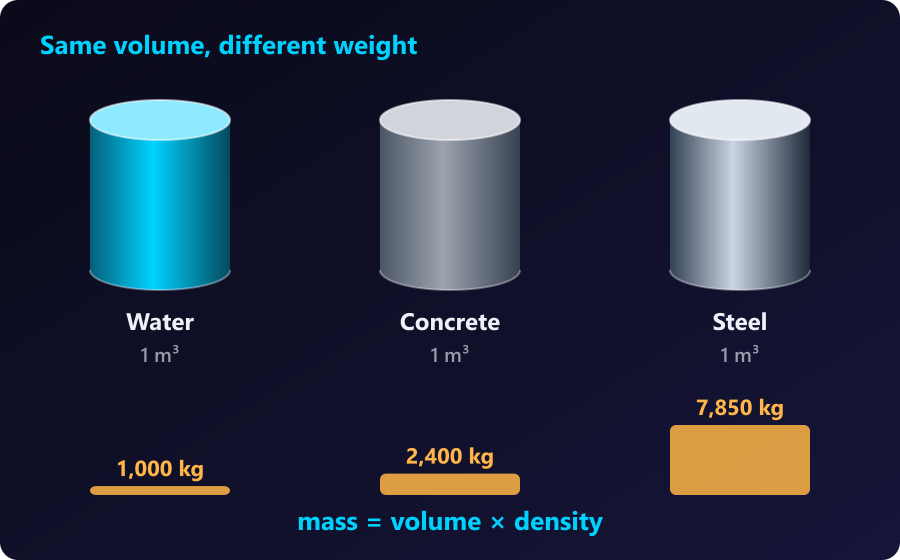
There are 3 common densities for cylinder problems:
| Material | Density (metric) | Density (US customary) |
|---|---|---|
| Water | 1 kg/L (1,000 kg/m³) | 8.34 lb per US gallon (62.4 lb/ft³) |
| Concrete | about 2,400 kg/m³ | about 150 lb/ft³ |
| Steel | about 7,850 kg/m³ (7.85 g/cm³) | about 490 lb/ft³ |
Water example. The 216.9 L water drum holds 216.9 × 1 kg/L ≈ 216.9 kg (478 lb) of water.
Concrete example. The 0.500 m³ concrete column weighs 0.500 × 2,400 ≈ 1,201 kg (about 2,650 lb).
Steel example. A solid steel bar with a diameter of 5 cm and a length of 1 m (100 cm) has a volume of π × 2.5² × 100 ≈ 1,963.5 cm³. Its mass is 1,963.5 × 7.85 ≈ 15,413 g, or 15.4 kg (34.0 lb).
The volume to weight calculator handles other materials.
Why Do Volume Conversions Cube the Length Factor?
Volume has 3 dimensions, so a length conversion factor gets cubed. 1 m = 100 cm, but 1 m³ = 100 × 100 × 100 = 1,000,000 cm³, not 100 cm³.
Picture a 1 m cube filled with sugar cubes 1 cm on each side. One row along the bottom edge holds 100 cubes. One layer holds 100 rows, or 10,000 cubes. The full box holds 100 layers, or 1,000,000 cubes.
The same rule works for every length unit:
| Length fact | Volume fact | Factor |
|---|---|---|
| 1 m = 100 cm | 1 m³ = 1,000,000 cm³ | 100³ |
| 1 cm = 10 mm | 1 cm³ = 1,000 mm³ | 10³ |
| 1 ft = 12 in | 1 ft³ = 1,728 in³ | 12³ |
| 1 yd = 3 ft | 1 yd³ = 27 ft³ | 3³ |
| 1 in = 2.54 cm | 1 in³ = 16.387 cm³ | 2.54³ |
The most common slip is dividing cm³ by 100 to get m³. That answer is 10,000 times too big. Convert the radius and height to metres before you use V = πr²h, and the answer comes out in m³ with no cube factor to remember.
How Do You Check a Conversion Is Sensible?
To check a conversion, compare it with an object you know. 5 reference points cover most cylinder problems:
- 1 L is a carton of milk, or a cube 10 cm on each side.
- 1 US gallon (3.785 L) is a large milk jug.
- 1 ft³ (28.3 L) is a small suitcase.
- 1 m³ (1,000 L) is a cube as tall as a kitchen counter on each side, or the water in a 1,000 L IBC tote.
- 1 yd³ (764.6 L) is about 4.5 loads in a large 6 ft³ wheelbarrow.
Run 2 checks on every answer:
- Direction. Converting to a bigger unit gives a smaller number. cm³ → L shrinks the number. L → ml grows it.
- Size. A kitchen pot of 5,000 L or a swimming pool of 3 L means a unit step went wrong.
Worked Example: A Cylinder Aquarium in Inches
A cylinder aquarium with an inside diameter of 18 in and a water depth of 24 in holds about 100 L, or 26.4 US gallons.
- Find the radius. r = 18 ÷ 2 = 9 in.
- Find the volume. V = π × 9² × 24 = π × 1,944 ≈ 6,107 in³.
- Convert to US gallons. 6,107 ÷ 231 ≈ 26.4 gal.
- Convert to litres. 6,107 × 0.016387 ≈ 100.1 L.
- Check the size. 26.4 milk jugs sounds right for a tank this big.
The water weighs about 100 kg (220 lb). Add the glass, gravel, and stand, and the floor carries well over 130 kg on a small circle. Check that a floor can take the load before you fill a large tank.
Frequently Asked Questions
What is the difference between a US gallon and a UK gallon?
A US gallon equals 3.785 L (231 in³), and a UK (imperial) gallon equals 4.546 L. 1 UK gallon ≈ 1.2 US gallons. Use US gallons for American products and UK gallons for older British and Canadian measurements.
Is 1 ml the same as 1 cm³?
Yes, 1 millilitre (ml) is exactly the same volume as 1 cubic centimetre (cm³). Medical and lab equipment often labels volume in cc, which means cm³.
How many litres are in a cubic metre?
There are 1,000 litres in 1 cubic metre (m³). A tank with a volume of 2.5 m³ holds 2,500 L.
How do I convert cubic inches to gallons?
Divide cubic inches by 231 to get US gallons. Divide cubic inches by 277.42 to get UK gallons.
How many cubic feet are in a cubic yard?
There are 27 cubic feet in 1 cubic yard, since 3 ft × 3 ft × 3 ft = 27 ft³.
Why is my cubic metre answer 10,000 times too big?
You divided cm³ by 100 instead of 1,000,000. 1 m = 100 cm, but 1 m³ = 100³ = 1,000,000 cm³. Convert lengths to metres before you calculate to skip this step.
How many cubic inches are in a cubic foot?
There are 1,728 cubic inches in a cubic foot, since 12 × 12 × 12 = 1,728.